

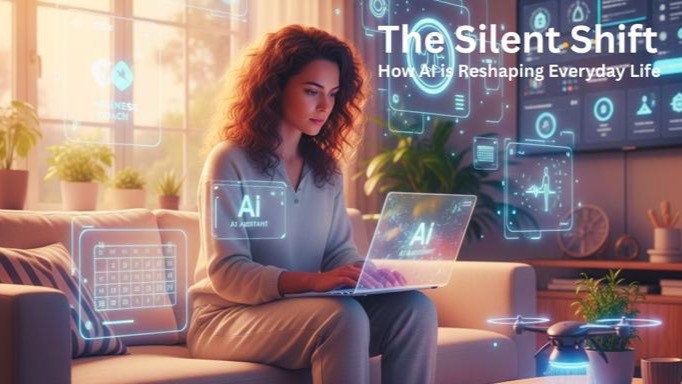
The world is entering a new phase where technology is no longer just following commands—it is starting to think, learn, and adapt on its own. This silent AI shift is happening across industries, devices, and daily life without many people fully realizing its impact. From search engines to smart assistants and automated systems, artificial intelligence is quietly reshaping how decisions are made, how work is performed, and how humans interact with digital tools. Understanding this transformation is important because it is not a distant future anymore—it is happening right now.
The Rise of Thinking Machines in the Modern World
Artificial Intelligence Moving Beyond Basic Automation
Artificial intelligence is no longer limited to simple rule-based tasks. Modern systems can analyze patterns, understand context, and improve their performance over time. This shift from basic automation to adaptive intelligence is changing how technology operates in everyday tools like search engines, recommendation systems, and digital assistants. The concept of thinking machines is becoming more practical as AI systems begin to simulate decision-making processes that were once exclusive to humans.
Machine Learning and Self-Improving Systems
Machine learning plays a major role in the silent AI shift by allowing systems to learn from data without being explicitly programmed for every outcome. These systems continuously refine their predictions based on user behavior and new information. As a result, technology becomes more accurate and efficient over time. This self-improving nature is what makes modern AI feel “intelligent,” even though it is powered by complex mathematical models rather than human thought.
From Tools to Intelligent Systems
Traditional technology was designed as a tool that required direct human control. Today, we are moving toward intelligent systems that can operate with minimal guidance. These systems can make recommendations, detect patterns, and even automate decisions in real time. This transition is redefining the relationship between humans and machines, turning passive tools into active digital partners that assist in problem-solving.
How AI Is Quietly Transforming Everyday Life
Personalized Digital Experiences
One of the most visible impacts of the AI revolution is personalization. Online platforms now adjust content, recommendations, and interfaces based on individual user behavior. This creates a more tailored digital experience where users see content that aligns with their interests and habits. Behind the scenes, AI analyzes massive amounts of data to deliver these personalized interactions in real time.
Smart Automation in Daily Tasks
Automation powered by AI is becoming a natural part of everyday life. From email filtering to voice assistants and smart home devices, AI handles repetitive tasks efficiently. This reduces human effort and increases productivity. Many of these systems operate silently in the background, improving convenience without requiring constant attention from users.
Invisible Decision-Making Systems
AI is increasingly involved in decision-making processes that users do not directly see. Whether it is financial predictions, content ranking, or security systems, algorithms are constantly evaluating data to make instant decisions. This invisible layer of intelligence is one of the most powerful aspects of the silent AI shift, as it influences outcomes without visible interaction.
The Future Impact of Thinking Technology
Changing the Nature of Work and Skills
As AI systems become more capable, the nature of work is also evolving. Many routine tasks are being automated, which shifts human focus toward creativity, strategy, and problem-solving. This change requires new skills, especially in digital literacy and AI collaboration. Workers are no longer just using tools—they are working alongside intelligent systems that assist in decision-making and execution.
Ethical Questions and Human Control
The rise of thinking technology also brings important ethical concerns. As AI systems gain more independence, questions about control, transparency, and responsibility become more critical. It is important to ensure that human oversight remains central in all AI-driven processes. Balancing innovation with ethical guidelines is essential for a safe and fair technological future.
The Long-Term Evolution of Artificial Intelligence
Artificial intelligence is expected to continue evolving rapidly in the coming years. Future systems may become even more advanced in understanding context, predicting behavior, and interacting naturally with humans. This long-term evolution suggests a world where AI becomes deeply integrated into infrastructure, communication, and decision-making at every level.
FAQs
What is the silent AI shift?
It refers to the gradual integration of artificial intelligence into everyday systems without most people noticing.
How is AI changing daily life?
AI is improving personalization, automating tasks, and supporting decision-making in digital systems.
Is AI really thinking like humans?
No, AI does not think like humans, but it can simulate intelligent behavior using data and algorithms.
Will AI replace human jobs?
AI may automate some tasks, but it will also create new roles focused on creativity and management of AI systems.
Why is AI important for the future?
AI improves efficiency, enhances decision-making, and supports innovation across industries.
Conclusion
The silent AI shift is transforming technology from simple tools into intelligent systems capable of learning, adapting, and influencing decisions in powerful ways. While this evolution brings major benefits in efficiency and personalization, it also raises important questions about control and responsibility. As technology continues to “think” more independently, understanding and guiding its development becomes essential. The future will not be defined by machines replacing humans, but by how effectively humans and intelligent systems work together.
